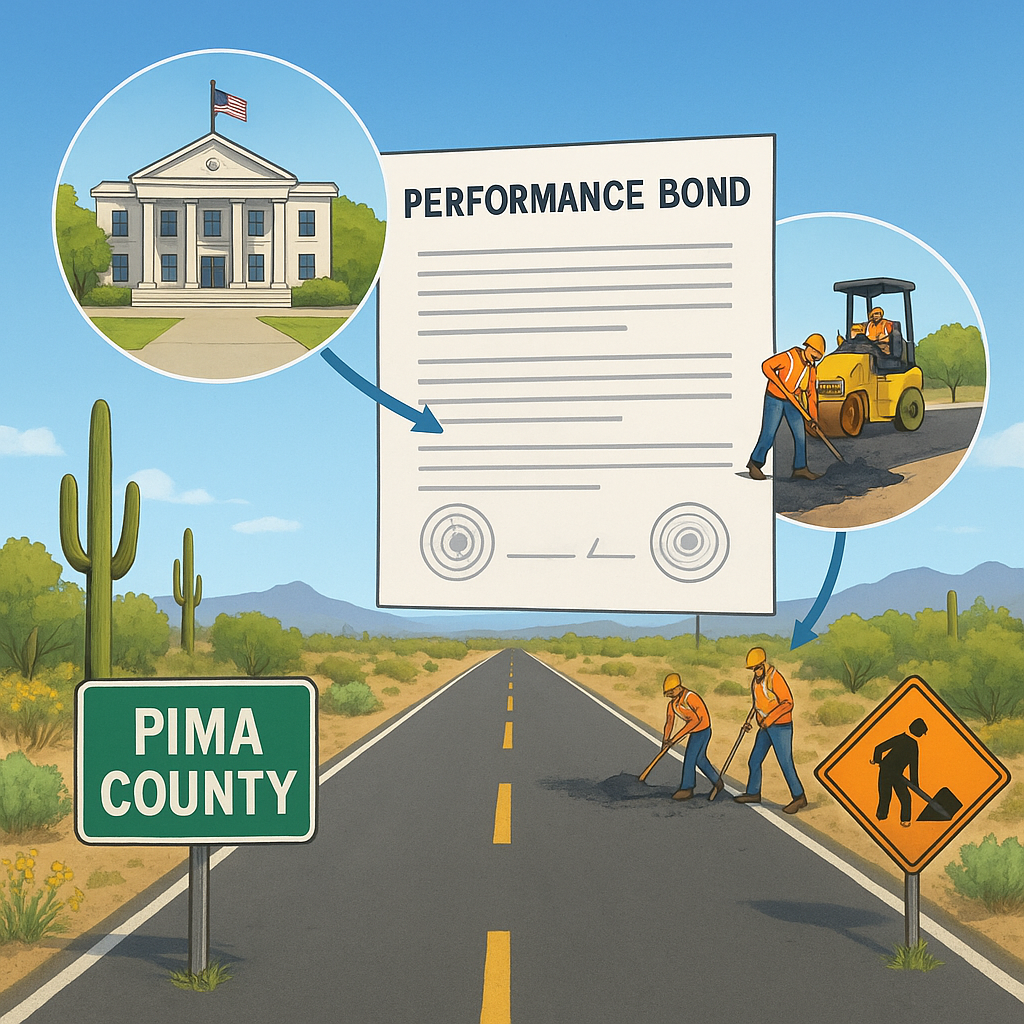
If you drive through Pima County, Arizona, you already know how important smooth, safe roads are. From Tucson to Ajo, pavement takes a beating from the desert sun, summer monsoons, and daily traffic. That’s why local agencies invest in pavement preservation, a smart way to extend the life of roads before they fall apart. But before a general contractor can start that work, there’s usually one key requirement: a Pima County AZ Pavement Preservation Performance Bond.
This requirement can feel confusing at first. What does a performance bond actually do? Who does it protect? And why does it run to the municipality? Let’s break it down in plain language.
What Is Pavement Preservation?
Pavement preservation is exactly what it sounds like. Instead of waiting for a road to crumble and then paying for a costly full reconstruction, local governments use preservation techniques to keep roads in good shape for longer. Think of it like changing the oil in your car. Regular maintenance costs a little now, but it prevents a huge engine failure later.
In Pima County, pavement preservation projects often include:
- Crack sealing to keep water out of the pavement base
- Sealcoating to protect asphalt from sun and oxidation
- Chip seals to restore surface texture and skid resistance
- Micro-surfacing to fill ruts and small surface defects
- Thin overlays to add a new wearing surface
These projects are usually smaller than major road reconstruction, but they still involve public money. That’s where performance bonds come in.
What Is a Pima County AZ Pavement Preservation Performance Bond?
A Pima County AZ Pavement Preservation Performance Bond is a type of financial guarantee. It promises that the general contractor will complete the pavement preservation work according to the contract terms. If the contractor fails to do the job, the bond provides money to help the municipality fix the problem.
It helps to think of a performance bond like a co-signer on a loan. When someone with limited credit wants to rent an apartment, a co-signer promises the landlord that the rent will be paid. If the renter doesn’t pay, the co-signer steps in. A performance bond works in a similar way, but for construction projects.
Three parties are involved:
- The contractor — also called the principal, who performs the work
- The municipality — also called the obligee, such as Pima County or a local town
- The surety company — the financial backer that issues the bond
When the bond runs to the municipality, it means the bond is written specifically to protect the public agency that hired the contractor. In this case, the bond does not protect the contractor. It protects Pima County taxpayers and the local government.
Why Does Pima County Require Performance Bonds?
Public road projects are funded by taxpayer dollars. Pima County wants to make sure that money is spent wisely and that the work gets done correctly. A performance bond adds a layer of security.
Imagine Pima County awards a pavement preservation contract to a general contractor. The contractor starts the work, but halfway through, the company runs into financial trouble and walks off the job. Without a performance bond, the county would have to find another contractor, renegotiate prices, and possibly pay twice for the same project. That’s frustrating for officials and unfair to taxpayers.
With a performance bond in place, the story changes. The county can file a claim with the surety company. The surety investigates the situation. If the claim is valid, the surety may hire a replacement contractor or provide money to complete the project. The municipality doesn’t get stuck holding the bag.
This is why the phrase “bond runs to municipality” matters. The bond is not a general business license or a simple permit. It is a promise directed at the local government that serves the public interest.
How Does a Performance Bond Work in Real Life?
Let’s use a practical example. Suppose Pima County hires a general contractor to apply a chip seal treatment on several miles of a rural road. The contract is worth $500,000. Before work begins, the contractor must provide a performance bond for the full contract amount.
If the contractor completes the chip seal on time and to the proper standards, the bond simply expires. The contractor never hears about it again. But if the contractor does poor work or abandons the project, the county can file a claim.
The surety company then reviews the claim. If the contractor truly failed to meet the contract, the surety has two main options:
- Hire another contractor to finish the job
- Pay the county up to the bond amount to cover the loss
This process gives Pima County confidence that the road project will be completed, even if the original contractor runs into problems.
How Much Does a Pavement Preservation Performance Bond Cost?
Contractors often ask about cost. A performance bond usually costs a small percentage of the total contract amount. For many contractors, the premium falls between 1% and 3% of the bond amount. However, the exact price depends on several factors.
Surety companies look at:
- The contractor’s financial history and credit score
- Experience with similar pavement preservation projects
- The size and complexity of the job
- The contractor’s available working capital
A newer contractor might pay a higher rate than an established company with a long track record. The best way to get an accurate estimate is to work with a surety bond professional who understands Arizona public works projects.
Common Misconceptions About Performance Bonds
There’s a lot of confusion around performance bonds. Let’s clear up a few common misunderstandings.
It is not insurance for the contractor. A performance bond protects the municipality, not the contractor. If a claim is paid, the contractor is generally expected to repay the surety company.
It is not a substitute for good project management. A bond won’t fix poor planning or low-quality materials. It only kicks in when the contractor fails to meet the agreement.
It does not cover routine maintenance after the project ends. Once the pavement preservation work is accepted, the bond obligation is generally released or reduced according to the contract terms.
Understanding these points helps contractors avoid surprises and helps the public understand why bonds exist in the first place.
Tips for General Contractors in Pima County
If you’re a general contractor bidding on pavement preservation work in Pima County, a performance bond is likely part of the process. Preparing ahead of time can make everything smoother.
- Keep your financial records organized. Surety companies want to see that your business is stable.
- Build a relationship with a surety bond professional. Having someone who knows Arizona bond requirements can save you time and money.
- Review the contract carefully. Know exactly what the pavement preservation project requires before you sign.
- Maintain a solid track record. Completing projects on time and within budget helps you qualify for better bond rates later.
- Plan for cash flow. Bond claims are rare, but contractors should always manage money responsibly to avoid project delays.
Taking these steps can help you qualify for the bond faster and keep your focus where it belongs: on the roadwork itself.
Why This Matters for Pima County Residents
You might not think about performance bonds when you drive to work or run errands. But these bonds play a quiet role in keeping your commute safer and your local tax dollars protected. They help ensure pavement preservation projects are finished properly, even when obstacles arise.
The next time you see a chip seal crew or a crack sealing operation on a Pima County road, remember there’s more going on behind the scenes. A performance bond is standing behind that work, giving the county a safety net and giving the public extra peace of mind.
For general contractors, understanding the Pima County AZ Pavement Preservation Performance Bond is an important step toward winning public contracts and building a trustworthy reputation. For residents, it’s a reminder that local road investments are guarded by more than just promises.
This information is provided for general educational purposes and should not be taken as legal or financial advice. Contractors and agencies should consult with qualified bond professionals for guidance specific to their projects.